The Handy map of the Moon
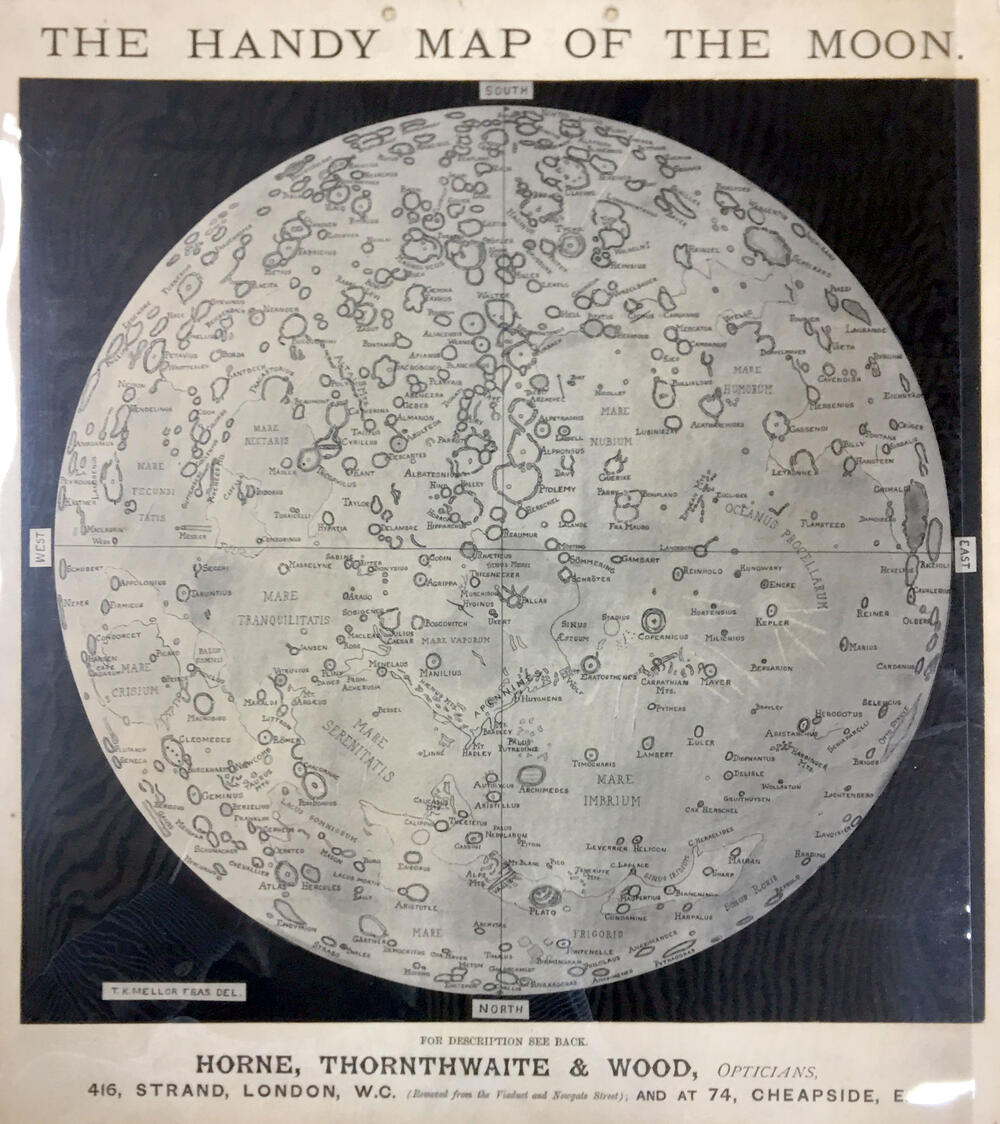
The Handy Map of the Moon.
The object of the present publication is to provide amateur astronomers and students of science with a map of our satellite which can be conveniently held in the hand while the eye is at the telescope, and the names have also been attached to the various objects in order that they may at once be easily recognised and identified.
Although about 300 formations have been thus named, including all the principal ones, a great number of minor ones have necessarily had to be omitted, as had they also been included, the map would have been so crowded as to be illegible. The moon is represented as she appears when viewed through a telescope with an astronomical or inverting eyepiece. If a terrestrial eyepiece be employed the picture must be turned upside down.
The most striking features upon the moon’s surface are the dark patches known as Mares or Seas, the bright streaks or rays, the craters of various sizes, the mountain ranges, and the clefts or so-called “rills.” The first were supposed to be really seas by the earlier observers, and the word is still retained for convenience, although it is not now supposed that there is any water upon the visible surface of the moon. They are plains or deserts which were at one time probably covered with water.
The rays are best seen when the moon is full, and appear to radiate from different craters, noticeably from four or five of them. They are brighter than the surrounding surface, but appear to be upon the same level, as if they were enormous cracks through which the more luminous matter from the interior had made its way to the surface.
The craters are usually divided into three classes, of which the smallest only are called craters, the larger ones being distinguished as “ring mountains,” and the largest of all as “walled plains.” Mr. Neison, in his excellent work upon the moon, observes that the walls of lunar craters are invariably steeper and more regular upon the inside than upon the outside. No satisfactory theory has yet been discovered which explains the formation of these gigantic rings.
The mountain ranges upon the moon are not so conspicuous as the great ranges upon the earth. The highest summits upon the moon are about the same height as the highest mountains upon the earth, but as the diameter of the moon is only about a quarter of that of our globe the mountains are proportionately four times as high as any terrestrial ones.
The clefts or “rills,” generally speaking, are not visible with small telescopes. The cleft at Hyginus is the principal one unless the great Alpine Valley also be classed with these formations; and near Triesnecker, upon the west side, is a complicated system of clefts which however requires to be looked for. There is a fine one a little to the west of Sirsalis, and another connects Hesiodus and Capuanus. Others may be detected in the triangle formed by Sabine, Arago, and Agrippa. Altogether more than a thousand of these singular objects have been discovered.
The Mare Crisium, the Mare Serenitatis, the Mare Imbrium, and the Mare Humorum are roughly circular, though appearing oval from the effects of foreshortening, and it may be noticed that the two halves of the Mare Tranquillitatis, if it were divided down the centre, would almost correspond to each other.
Among the principal mountain formations may be noticed:—
Tycho, a magnificent ring mountain, about 54 miles in diameter, the walls being a series of terraces both inside and outside. The surface of the interior, as in most of these formations, is much lower than the general surface outside, being in this case no less than 17,000 feet below the top of the walls. It is the principal centre of the rays, which appear to shoot from Tycho in all directions and to prodigious distances; one may be noticed which crosses the Mare Serenitatis and has been seen by some observers to pass around the moon out of sight near [...]. Tycho contains a central peak 6,000 feet high.
Copernicus, a very similar ring mountain to Tycho, 56 miles in diameter and 11,000 feet deep. The central peak has several heads of which only two are easily visible. It is also a ray centre. There are several small craters in the interior.
Plato, a large walled plain 60 miles in diameter, the walls rising around like an amphitheatre. The bottom is dark, with, however, some bright markings which are among the most difficult objects upon the moon to be satisfactorily seen. There is no central peak, but about 40 small craters are sprinkled over the interior and require a good glass to show them. At one end the wall has slipped down a little. To the south of it is Pico, a solitary peak, 8,000 feet high, twice the height of Snowdon. A number of small peaks about here have very much the appearance of small stones which have fallen upon a smooth surface of plaster of Paris.
Aristarchus, about 28 miles in diameter, is the most brilliant object upon the whole moon. It is also a ray centre. Towards the east is a high bright plain, looking very much like a flare from a star. Close to Aristarchus is Herodotus, 23 miles in diameter.
Gassendi, about 55 miles in diameter, has a cluster of three peaks in the centre. In the north the wall has broken into by a smaller and probably more recently formed crater, and in the south the walls sink into the plain, or has the Mare Humorum risen above the walls and overflowed into the interior? A large number of delicate rills have been discovered in Gassendi.
Petavius is remarkable for having a double wall. The central peak is connected to the eastern wall by a fine rill, which Mr. Neison observes is visible in a telescope of two inches aperture.
Clavius is one of the largest ring mountains, being 142 miles in diameter. It forms a particularly fine object when on the terminator, as the eastern wall, the crests and pinnacles of which are very high, is lit up by the morning sun while the vast interior is still in darkness. This bright wall, like a golden loop, stretches far into the unillumined portion of the disc. The interior of Clavius contains two large craters, four or five small ones, and sixty or seventy crater pits.
Cleomedes is 78 miles in diameter and of irregular shape. The interior peaks have been very differently drawn by various observers. Gruithuisen drew a curious formation something like a chess board with nine squares near the west wall. This can be searched for best when the moon is past full, on account of the shadows cast by the wall.
Kepler, like Copernicus, is surrounded by a halo or cloud of light from which streaks radiate in all directions. They are generally more curved and shorter than those from Tycho.
Bullialdus, 38 miles in diameter; the walls are very thick, with many terraces and buttresses. The central peak (3,000 feet high) has four heads.
Messier, upon the Sea of Fecundity, consists of two small craters from which radiate streaks, giving the whole very much the appearance of a comet. These two small craters are of much interest, as the earlier observers pictured them as being exactly alike, whereas now the one to the west is smaller and more oval than its companion.
Theophilus contains the deepest central abyss of any mountain upon the moon, the walls rising no less than 18,000 feet or over three and a half miles above the floor. If placed in this enormous pit Mount Blanc would sink far out of sight and Cotopaxi would just show his summit as a small peak above the walls.
Wargentin, near the limb, appears to be a ring mountain of which the central cup has been filled up with lava or other material, but has not overflowed. It resembles a coin or grindstone.
Linné, in the Sea of Serenity, is another case of probable small change on the surface of the moon in recent years. The earlier observers describe it as dark and deep, whereas now it is shallow and bright.
Sinus Iridium. This magnificent bay is always easily visible and is a most striking object. The distance between the two headlands Cape Heraclides and Cape Laplace is 134 miles. This would make it about the same size as the Gulf of Lyons, or of the Bay of Plenty in New Zealand.
The Valley of the Alps is one of the most astonishing objects upon the whole lunar surface. It is a vast gorge 83 miles long and from 3 to 6 miles wide, cutting through the centre of the Alps and uniting the Mare Imbrium and the Mare Frigoris.
The Apennines are the principal mountain range upon the moon. They are 460 miles long, Mount Huyghens the highest peak being 18,000 feet high. Like many ranges of mountains upon the earth they are much more steep and rugged upon one side than upon the other, the rugged side in their case being the one which abuts upon the Mare Imbrium.
Other interesting features which may be looked for are the different shadings upon the floors of Archimedes and Schickard, and the curious object called by Mr. Webb the “Straight Wall,” between Thebit and Birt in the Mare Imbrium. This, as he observes, seems regular enough to be a work of art. [...]
Most interesting are the appearances presented by all the craters when near the terminator, as the sunlight gradually creeps over the rough and volcanic surface of the moon, throwing everything as it does so into high light and dark shadow. Distinct changes may be noticed even in the course of an observation extending only over one or two hours. New points of light are constantly appearing like stars out of the darkness, and these being united together by the increasing sunlight gradually form themselves into the old familiar objects, with which after a month’s absence we are always pleased to renew our acquaintance.
It may truly be said that there is no other branch of astronomy, the pursuit of which affords such satisfactory results to the owners of small telescopes, as the study and contemplation of the lunar surface.