Genuina Corporis Lunaris Facies
Scale 1: 12 400 000
The true appearance of the Moon
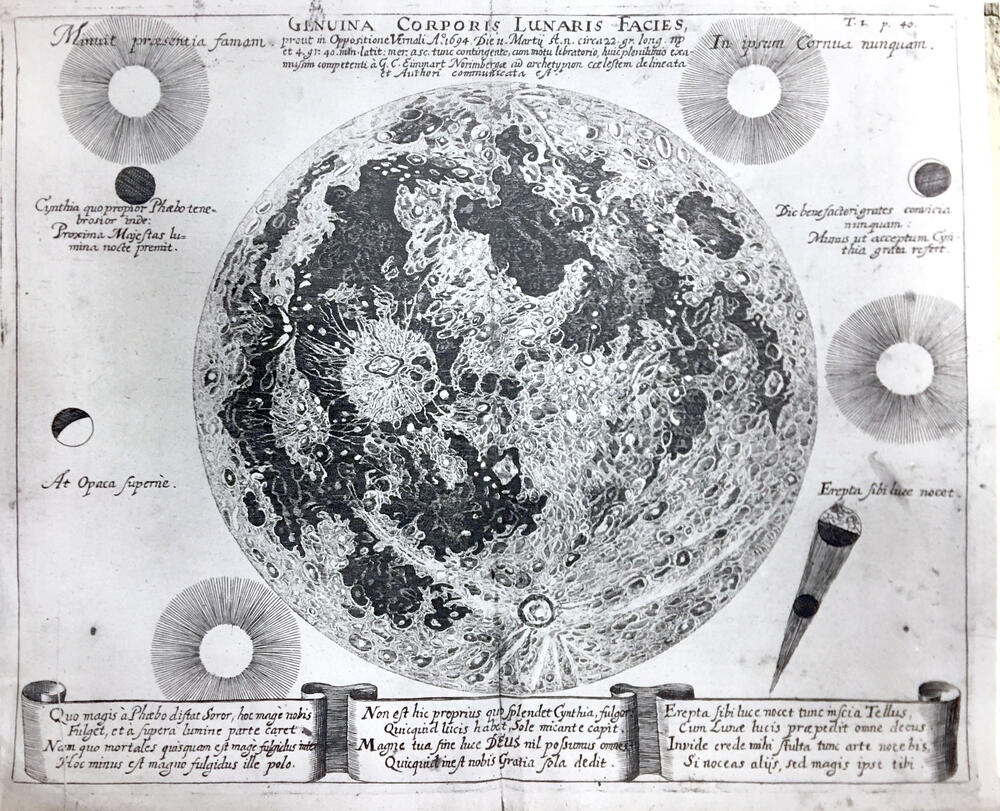
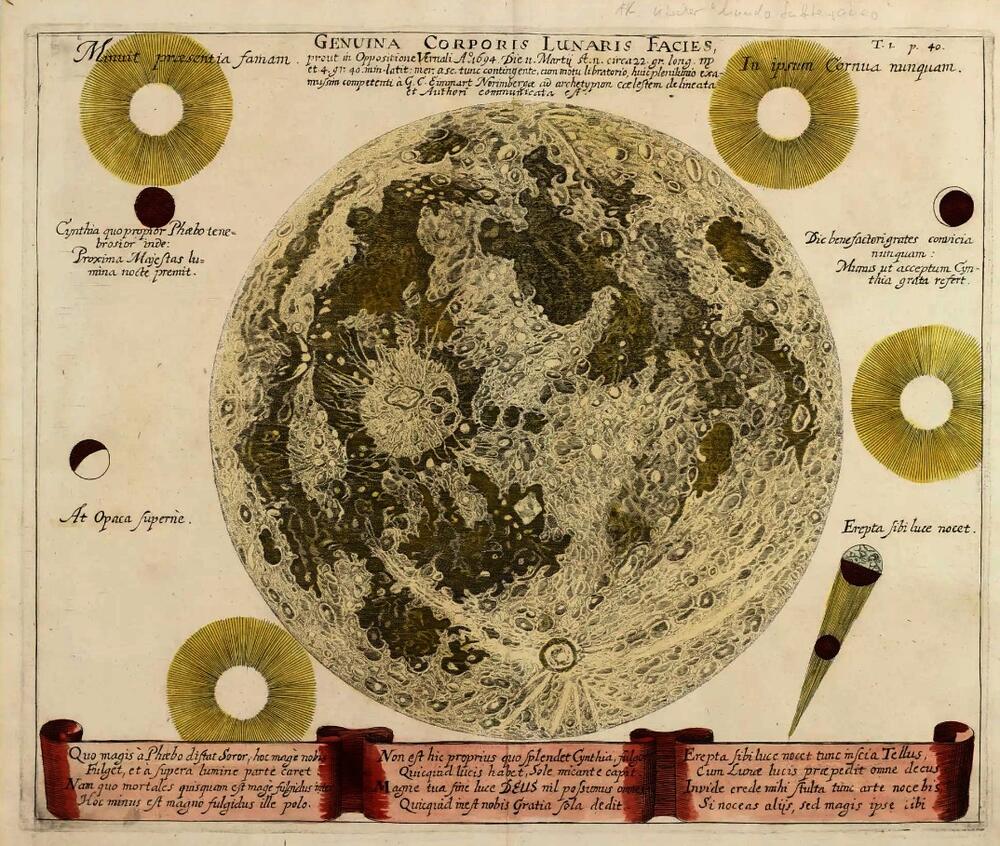
GENUINA CORPORIS LUNARIS FACIES,
prout in Oppositione Verna A. 1694. Die 11. Martii st. n. circ. 22. gr. long. mer. et 4.91′40″ min. latit. mer. asc. tunc contingente, cum motu libratorio, huic plenissimo erat exaussim competentia à G. C. Eimmarto Norimbergæ ad archetypon cœleste delineata et Authori communicata.
The True Appearance of the Lunar Body, as it appeared near the spring opposition on 11 March 1694 (New Style), at approximately 22° of selenographic longitude, with the corresponding meridional latitude and the Moon's libration taken into account; drawn with the greatest possible accuracy by Georg Christoph Eimmart of Nuremberg from the heavenly original (that is, from the Moon itself) and communicated to the author.
Nunquam præsentia famam.
Presence never equals reputation.
= Although the Moon is actually nearest the Sun, it is invisible.
In vacuo forma nunquam.
Form never exists in a vacuum.
=Probably referring to the fact that the Moon's appearance depends upon illumination.
New Moon
Cynthia quo propius Phœbo tenebrosior inde: Proxima Majestatis lumina nocte premit.
The nearer Cynthia is to Phoebus, the darker she becomes; when nearest, she suppresses the majesty of the lights of night.
="Cynthia" = Moon., "Phoebus" = Sun. At New Moon the Moon is closest to the Sun in the sky and therefore invisible.
Last Quarter
Dic benefactori grates convicia nunquam. Mimus ut acceptum Cynthia grata refert.
Never repay your benefactor with insults. Like an actor in a mime, grateful Cynthia returns what she has received.
= The Moon faithfully reflects the Sun's light. Therefore humans should likewise repay kindness with gratitude.
Lunar Eclipse
Erepta sibi luce nocet.
Deprived of her own light, she suffers.
= This is the lunar eclipse. Strictly speaking the Moon has no intrinsic light, but its reflected light has been taken away by the Earth's shadow.
Ribbons:
Quo magis a Phœbo distat Soror, hoc magis nobis Fulget, et a supera lumine parte caret. Nam quo mortales quisquis est magis sidus inter, Hoc minus est magno fulgidus ille polo.
The farther the sister is from Phoebus, the more brightly she shines for us, though part of her upper light is lacking. For whoever among mortals becomes like a star, shines the less beside the great heavens.
= Astronomy: The Moon appears brightest when opposite the Sun.; Moral: Human glory is insignificant compared with Heaven.
Non est hic proprius quo splendet Cynthia fulgor. Quicquid lucis habet, Sole micante capit. Magna tua sine luce Deus nil possunt omnia. Quicquid inest nobis Gratia sola dedit.
This brightness with which Cynthia shines is not her own. Whatever light she possesses she receives from the shining Sun. Without Your great light, O God, nothing can accomplish anything. Whatever is within us has been given solely by Grace.
= The author compares Moon : Sun with Human : God. It is a theological analogy.
Erepta sibi luce nocet tunc inscia Tellus, Cum Lunæ lucis præpedit omne decus. Invide crede mihi stulta tunc arte nocēbis Si noceas aliis, sed magis ipse tibi.
When Earth unknowingly takes away her light, she herself suffers, for she hinders all the beauty of the Moon's brightness. Envious man, believe me: by such foolish conduct you harm yourself, if you injure others—but yourself even more.
= Earth blocks the sunlight reaching the Moon.
Image: LPL, E. Whitaker papers