Pleni Lunium, Luna Crescens
Scale 1: 12 100 000
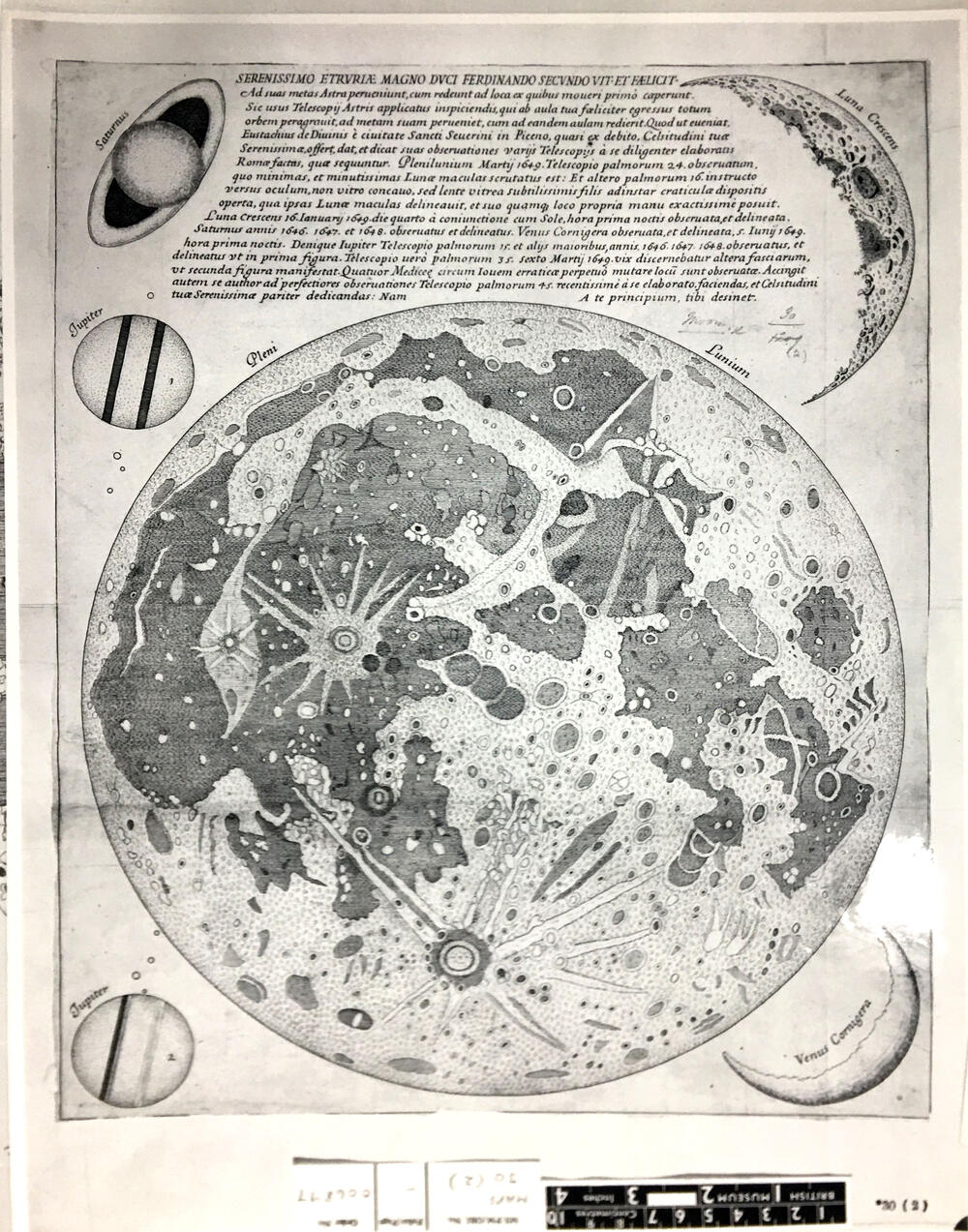
Transcription (Latin):
SERENISSIMO ETRVRIAE MAGNO DVCI FERDINANDO SECVNDO VIT. ET FELICIT.
Ad suas metas Astra perveniunt, cum redeunt ad loca ex quibus moueri primo coeperunt. Sic usus Telescopij Astris applicatus inspiciendis, qui ab aula tua feliciter egressus totum orbem peragrauit, ad metam suam perueniet, cum ad eandem aulam redierit. Quod ut eueniat, Eustachius de Diuinis è ciuitate Sancti Seuerini in Piceno, quasi ex debito, Celsitudini tuae Serenissimae, offert, dat, et dicat suas obseruationes varijs Telescopijs à se diligenter elaboratas Romae factas, quae sequuntur. Plenilunium Martij 1649. Telescopio palmorum 24. obseruatum, quo minimas, et minutissimas Lunae maculas scrutatus est: Et altero palmorum 16. instructo versus oculum, non vitro concauo, sed lente vitrea subtilissimis filis adinstar craticulae dispositis operta, qua ipsas Lunae maculas delineauit, et suo quàmq[ue] loco propria manu exactissime posuit. Luna Crescens 16. Ianuarij 1649. die quarto à coniunctione cum Sole, hora prima noctis obseruata, et delineata. Saturnus annis 1646. 1647. et 1648. obseruatus et delineatus. Venus Cornigera obseruata, et delineata, 5. Iunij 1649. hora prima noctis. Denique Iupiter Telescopio palmorum 15. et alijs maioribus, annis 1646. 1647. 1648. obseruatus, et delineatus vt in prima figura. Telescopio uerò palmorum 35. sexto Martij 1649. vix discernebatur altera fasciarum, vt secunda figura manifestat. Quatuor Mediceae circum Iouem erraticae perpetuò mutare locū sunt obseruatae. Accingit autem se author ad perfectiores obseruationes Telescopio palmorum 45. recentissimè à se elaborato, faciendas, et Celsitudini tuae Serenissimae pariter dedicandas: Nam A te principium, tibi desinet.
English Translation:
To the Most Serene Grand Duke of Tuscany, Ferdinand II, May He Live and Prosper.
The stars reach their appointed goals when they return to the places from which they first began to move. In the same way, the use of the telescope applied to the observation of the stars—which, having set out auspiciously from your court, has traversed the entire world—will reach its own goal when it returns to the same court.
To this end, Eustachio Divini of the city of San Severino in Piceno, as if by duty, offers, gives, and dedicates to Your Most Serene Highness his observations carefully made with various telescopes in Rome, which follow:
- The Full Moon of March 1649, observed with a 24-palm telescope, with which he examined the smallest and most minute spots on the Moon; and with another 16-palm telescope fitted toward the eye, not with a concave glass but covered with a lens of very fine threads arranged like a grid, with which he drew the very spots of the Moon and placed them in their proper places with his own hand most exactly.
- The Crescent Moon on 16 January 1649, on the fourth day after conjunction with the Sun, observed and drawn at the first hour of the night.
- Saturn observed and drawn in the years 1646, 1647, and 1648.
- Horned Venus observed and drawn on 5 June 1649, at the first hour of the night.
- Finally, Jupiter observed and drawn with a 15-palm telescope and other larger ones in the years 1646, 1647, and 1648, as shown in the first figure. With a true 35-palm telescope on 6 March 1649, the other band was scarcely distinguishable, as the second figure shows. The four Medicean stars wandering around Jupiter were observed continually changing their positions.
The author is now preparing to make more perfect observations with a 45-palm telescope most recently constructed by himself, and to dedicate these likewise to Your Most Serene Highness: For
From you the beginning, to you it shall end.
Original copy at the British Library